Why your skin changes after 30 — and what you can do about it
From 30, your skin fundamentally changes: less collagen, slower regeneration, hormonal shifts. Learn what happens biologically — and how you can effectively counteract it.

At 25, your skin was still radiant, elastic, and regenerated overnight. You could sleep like a log and still wake up with a flawless face.
Then your 30th birthday arrives — and suddenly you get stress-induced pimples, fine lines turn into real wrinkles, and even the best moisturizer no longer seems to work properly.
This is no coincidence. Your skin fundamentally changes from 30 onwards — not just on the surface, but at a cellular level. And while that might sound frustrating at first, the good news is:
These changes are predictable. And if you understand them, you can proactively address them.
The biological reality: What happens to your skin after 30?
To understand why your skin changes after 30, you need to know what happens beneath the surface.
Your skin consists of 3 layers:
the dermis (the layer underneath, where collagen and elastin reside) and the hypodermis (fatty tissue).
Up to the age of 25, your skin regenerates approximately every 28 days.
This means: All dead cells are broken down and replaced by new ones. Your collagen production is in full swing, your elastin fibers are firm, and your skin barrier is strong enough to retain moisture.
From 30, something crucial happens:
Your collagen production decreases by about 1% per year. This sounds minimal — but over ten years, that means 10% less collagen. At the same time, the cell renewal process slows down.
Instead of every 28 days, your skin now regenerates every 35-40 days. Your skin becomes thinner, less elastic, and wrinkles appear faster.
In parallel, your skin loses moisture. This is because the natural moisture barrier (the so-called hydrolipid film) produces fewer oils and natural moisturizing factors from the age of 30.
For dry and dehydrated skin, Skinbooster are among the most popular treatments to intensively moisturize the skin.
The result is often: Your skin becomes drier, appears duller, and new lines form faster.
The underestimated problem: Hormonal changes and stress
It's not just collagen that decreases from 30 onwards. Your hormone production also changes.
In women, estrogen levels slowly but steadily decline — especially from mid-30.
Estrogen is crucial for a healthy skin barrier and moisture retention. Less estrogen means: less moisture protection, more sensitivity, faster-appearing wrinkles.
Additionally, there's the psychological factor:
At 30 years old, you often enter a phase of life with more responsibility — professional demands, perhaps family, financial worries. And stress is a major skin killer.
Chronic stress increases your cortisol levels, which in turn leads to more inflammation in the skin, slows down collagen production, and weakens the skin barrier.
That's why your skin doesn't just age externally from 30 onwards — it also becomes more sensitive, reactive, and prone to problems you never had in your 20s.
What you can specifically do — the anti-aging strategy from 30 onwards
The good news: These biological changes are completely normal — and there are proven ways to deal with them. The key is not to expect a single solution, but to build a holistic system.
First, the basics: A good skincare routine becomes essential from 30 onwards. This doesn't mean you didn't have to take care of your skin before — but the demands increase.
A good vitamin C serum in the morning, a retinol product in the evening (initially 2-3 times a week, later daily), and a rich night cream become essentials. These products address the biological problems: vitamin C and retinol stimulate collagen production, and the night cream strengthens your skin barrier.
Those who want to support their skin from within are often also interested in a Vitamin C Infusion, which is used to supply the body with high-dose vitamin C.
But skincare alone is not enough to stop real signs of aging. This is the most important insight. Once wrinkles are visible — real wrinkles, not just fine lines — superficial products have reached their limits.
Hyaluron, Botox or PRP? Which one is suitable?
This is the moment when treatments like hyaluronic acid, Botox, or PRP become useful. These address the actual problem: the missing volume and the weak collagen structure.
Hyaluron treatment
A hyaluronic acid injection into the cheeks instantly restores volume. This is not superficial — it acts like a new layer of skin beneath the surface.
If you have wrinkles at rest (so-called static wrinkles), hyaluron is the solution.
Botox treatment
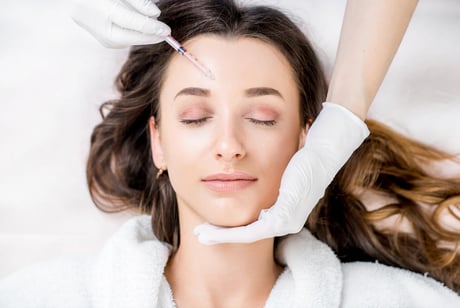
If you have dynamic wrinkles (which appear when you speak, smile, or frown), Botox is more effective — it stops the muscle movements that cause the wrinkles. If you have dynamic wrinkles like forehead lines, frown lines, or crow's feet, Botox is often the most effective treatment option.
Vampire Facelift with PRP
And then there's PRP (Platelet-Rich Plasma therapy). PRP stimulates your own collagen production — it's like a turbocharger for your body's anti-aging processes.
Anti-Aging Infusion
In addition to treatments like Botox, Hyaluron or Profhilo Treatment, the Anti-Aging Infusion is also very popular.
By specifically supplying the body with antioxidants, vitamins, and micronutrients, it can support general well-being and make a valuable contribution to a holistic anti-aging strategy.
Many patients combine Anti-Aging Infusions with aesthetic treatments to further promote skin quality, radiance, and vitality.
Many people aged 35 and over use a combination: PRP to stimulate collagen, Botox to prevent dynamic wrinkles, and Hyaluron to restore volume. This is the modern reality of anti-aging from 30 onwards.