Polynucleotides, Botox, Hyaluron or Sculptra?
Polynucleotides are not inherently better than Botox®, Hyaluron, or Sculptra®. Each of these treatments addresses a different problem: polynucleotides primarily target skin quality, Botox® targets dynamic wrinkles, hyaluronic acid fillers focus on volume and contours, and Sculptra® on gradual collagen stimulation in deeper tissue layers.

What exactly are polynucleotides?
Polynucleotides, or PN for short, consist of longer chains of nucleotides – the building blocks of DNA. The preparations used in aesthetic medicine contain highly purified DNA fragments, mostly obtained from fish of the Salmonidae family.
The popular term 'salmon sperm treatment' is therefore eye-catching but medically inaccurate:
No sperm is injected, but rather a purified product prepared for its specific application.
Polynucleotides and PDRN are often equated in the beauty sector. Scientifically, however, the terms are not entirely synonymous.
They differ, among other things, in chain length and molecular weight; furthermore, composition, concentration, and regulatory status can vary depending on the product.
Statements about efficacy, number of sessions, or suitability should therefore always refer to the actual preparation used.
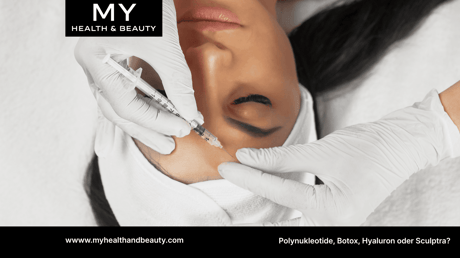
During a polynucleotide treatment at MY HEALTH & BEAUTY, the active ingredient is injected into the skin with fine needles.
The goal is a gradual improvement in skin quality – no change in facial expressions and no targeted lip augmentation, cheek augmentation or facial contours.
Botox® treatment is more suitable if:
- a wrinkle primarily appears when frowning, raising eyebrows, or smiling,
- you want to reduce an overactive facial expression in a clearly defined area,
- muscle activity is the primary cause of the problem.
Polynucleotides are more suitable if:
- the skin appears fine, crinkled, or dry even at rest,
- the general skin quality is the focus, rather than a single wrinkle,
- you do not want volume augmentation and no change in facial expressions.
Are polynucleotides an alternative to Botox®?
Only if your primary goal is not the relaxation of dynamic muscles.
For a pronounced frown line, polynucleotides can support skin quality, but they cannot stop the muscle movement behind the wrinkle. Therefore, they are not an equivalent substitute for Botox® in dynamic wrinkles.
Conversely, Botox® does not automatically improve dryness, pore appearance, or the general quality of thin skin.
In selected cases, both methods can be part of a treatment plan: Botox® addresses movement, Polynucleotides Cologne addresses skin quality.
Whether and at what time interval a combination is sensible is decided by the treating physician after examination.
What is better for my skin – Hyaluron treatment or polynucleotides?
This depends first on what is meant by 'Hyaluron'. Hyaluronic acid is used both in more stable fillers and in less cross-linked or non-cross-linked skin boosters. These products do not pursue the same goal.
Polynucleotides or Hyaluron fillers
A hyaluronic filler is used to specifically build volume, smooth transitions, or define contours.
The change is usually immediately noticeable, although swelling can affect the early result. Typical examples include lip modeling, cheek augmentation Berlin or the treatment of certain deeper wrinkles.
Polynucleotides do not work as classic volume fillers. The result develops gradually and is more evident in texture, moisture, elasticity, and fine lines.
In brief:
- For volume and contour, a hyaluronic filler is usually more suitable.
- For regenerative improvement of skin quality, polynucleotides may be more suitable.
- In cases of simultaneous volume loss and impaired skin quality, a medically planned combination approach can be beneficial.
- Polynucleotides Düsseldorf or Hyaluron
With a Hyaluron treatment Cologne, the comparison is closer. Here too, the focus is on moisture, smoothness, and skin quality, not primarily on significant volume.
Hyaluronic acid binds water in tissue; polynucleotides are additionally used for their potential biostimulatory and regenerative effects.
If intense hydration and a fresh glow are primarily desired, a hyaluronic acid-based skin booster like Profhilo® treatment may be considered.
For thin, sensitive, or structurally uneven skin, the focus might rather be on Polynucleotides Berlin. The product used and the individual skin condition are more important than the generic term 'skin booster'.
What is better – Sculptra® or Polynucleotides?
Sculptra® and Polynucleotides Leipzig are both often classified as biostimulators. Nevertheless, they are not interchangeable.
Sculptra® contains poly-L-lactic acid, or PLLA. The preparation is injected into deeper tissue layers and stimulates collagen regeneration there over a longer period.
It is primarily considered when a larger loss of firmness or volume needs to be compensated. The effect develops slowly and can last for an extended period.
Polynucleotides are typically used more superficially or intradermally.
Their focus is on the skin's texture:
Hydration, fine lines, elasticity, and texture. They are therefore also suitable for sensitive areas where no pronounced volume enhancement is desired.
Which treatment suits which skin problem?
Dynamic Wrinkles
Wrinkles that significantly intensify when frowning, smiling, or raising eyebrows are primarily characterized by muscle activity. Here, Botox® is usually more targeted than polynucleotides, hyaluronic acid, or Sculptra®.
Fine Lines and Crinkled Skin Texture
If the skin appears finely wrinkled, dry, or thin even without movement, improving skin quality may be the priority. Polynucleotides or another skin booster may then better suit the goal than pure muscle relaxation.
Volume Loss and Less Defined Contours
For sunken cheeks, a less defined jawline, or the desire for lip volume, a shaping hyaluronic filler is usually more directly controllable.
For more extensive loss of firmness and volume, a collagen biostimulator like Sculptra® may also be considered.
Dark Circles and Fine Skin Under the Eyes
'Dark circles' are not a uniform finding. Dark shadows can result from pigmentation, visible vessels, very thin skin, an anatomically deep tear trough, or a combination of these factors.
For thin, finely lined skin, a Lumi Eyes treatment with polynucleotides specifically tailored to the eye area may be considered.
For a pronounced volume deficit, another treatment might be more suitable after careful medical examination.
For predominantly pigment-related dark circles, neither a filler nor a polynucleotide is automatically the right solution.
Especially for the eye area, decisions should not be based solely on a trend or product name.
Dull Skin and Lack of Glow
Several skin boosters can be considered here. Polynucleotides focus on regenerative skin improvement.
Mesotherapy with NCTF 135 HA, for example, combines non-cross-linked hyaluronic acid with other components and is primarily used for hydration and a fresher complexion.
Vampire lifting with PRP uses the body's own blood components. Which option is more sensible depends on skin type, tolerability, and treatment goals.
How long does it take for polynucleotides to work?
Polynucleotides are not a classic immediate treatment. Better hydration or a fresher appearance may be noticeable in some patients after just a few days. However, changes in skin structure and elasticity develop gradually.
At MY HEALTH & BEAUTY, the final result of a treatment is usually assessed after about four to six weeks. The exact course depends on the preparation, the treated area, the initial skin condition, and the number of sessions.
A realistic timeline looks like this:
Immediately after treatment: Small bumps, redness, or swelling at the injection sites are possible. These are not to be equated with the later result.
After a few days: The skin may appear more hydrated and fresher.
After several weeks: Texture, fine lines, and elasticity can gradually improve.
After completing the treatment series: Only now can the overall result be meaningfully evaluated.
How often are polynucleotides treated?
Often, the initial treatment consists of two to three sessions spaced several weeks apart. However, this is not a universal protocol. Some products, skin conditions, and areas require a different interval or number of applications.
After the initial series, a refresh may be beneficial. When it occurs depends on how the skin develops, which preparation was used, and what result is to be maintained. A rigid recommendation like 'every six months for everyone' would be too generalized medically.
What does a polynucleotide treatment cost?
At MY HEALTH & BEAUTY, polynucleotide treatment currently starts from €229.99 per session. The total costs depend on how many sessions are medically recommended and which area is treated.
For the eye area, a specially designed product or treatment concept may be used.
Therefore, the costs for 'polynucleotides against dark circles' should not be equated with a general facial treatment without examining the findings and the product used.
The decisive factor is the current price on the respective treatment page or in the personal treatment plan.
What do polynucleotides really achieve? An honest look at the study situation
The scientific results are promising but not yet strong enough for promises of a cure or a general superiority over other aesthetic procedures.
A systematic review identified nine studies with a total of 219 treated individuals. Improvements in wrinkles, skin structure, and elasticity were reported, among other things; side effects were predominantly mild and temporary.
However, the included studies were only rated as low to moderately high quality. Different products, injection techniques, areas, and measurement methods also make direct comparison difficult.
In a small randomized split-face study with 27 participants, polynucleotides and non-cross-linked hyaluronic acid were compared in the eye area.
Both sides improved; for individual measurements such as skin roughness and pore volume, the polynucleotide side performed better. However, a single small study does not prove a general superiority of polynucleotides over all hyaluronic acid products.
Newer observational data on the eye area and other facial areas complement the picture, but do not replace large, independent, long-term comparative studies.
A realistic classification is therefore as follows:
Well-justifiable goal: a gradual improvement in hydration, fine lines, elasticity, and skin texture.
Not well-justifiable: promises of a facelift without surgery, permanent results, or the claim that polynucleotides are generally more effective than Botox®, Hyaluron, or Sculptra®.
Still open: the optimal product, the best dose, the ideal session interval, and long-term superiority over established alternatives.
Side Effects and Contraindications
After a polynucleotide injection, temporary redness, swelling, small bruises, tenderness, or small bumps at the injection sites may occur.
Even with generally good tolerability, it remains an injection treatment. Rare, more serious complications such as infections or allergic reactions cannot be completely ruled out.
Treatment should not be carried out, or only after careful medical examination, in cases of:
- pregnancy or breastfeeding,
- an acute infection or inflammation in the treated area,
- known allergy to components of the product used,
- relevant fish allergy if the preparation is derived from salmonids,
- diseases or medications that can affect blood clotting, wound healing, or immune responses.
- Medications – especially blood thinners – should never be discontinued independently for an aesthetic treatment. The treating physician must be informed in advance about illnesses, allergies, and all medications taken.
Conclusion: Not the method, but the treatment goal decides
Polynucleotides are particularly interesting if you want to improve the quality of thin, dry, or finely lined skin without specifically building volume or changing facial expressions. For dynamic wrinkles, Botox® is usually more precise.
For lips, cheeks, or contours, hyaluronic acid is more controllable. For more extensive loss of firmness and volume, Sculptra® can be a more suitable biostimulatory option.
Sometimes, not a single method is the answer, but a sensible sequence or combination. The prerequisite is that each treatment addresses a clearly defined problem.
Would you like to know if polynucleotides suit your skin type? In a free medical consultation at MY HEALTH & BEAUTY, skin condition, treatment goals, and possible alternatives are discussed. Learn more about polynucleotide treatment.